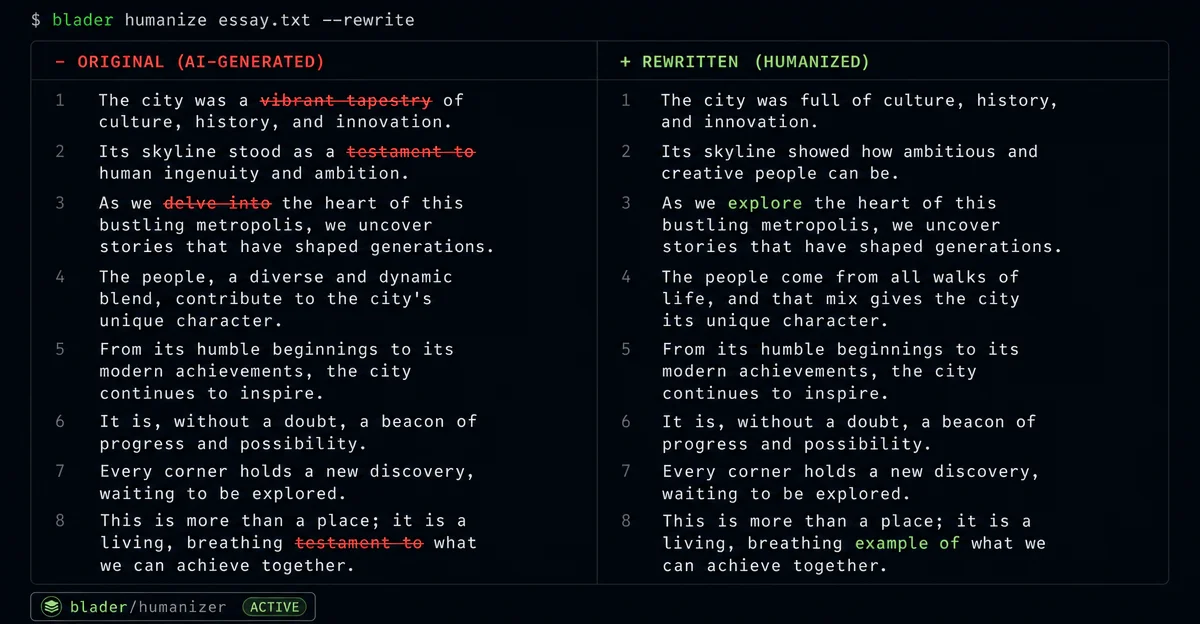
blader/humanizer: the 33-pattern skill that rewrites AI tells out of your text
23.5K-star Claude Code skill that detects and rewrites 33 AI writing patterns — with voice calibration and honest caveats.

리서치 브리프
23,500 stars. One file. No API calls. The entire contract is a single 621-line
SKILL.md that teaches Claude Code (and OpenCode) to detect and rewrite 33 specific patterns that mark a piece of writing as machine-generated. Today it hit GitHub's trending list — here's what it actually does, how to wire it in, and where it falls short.콘텐츠 카드를 불러오는 중…
What the skill does — mechanically
Most "humanizer" tools are blunt instruments: swap "utilize" for "use," delete adverbs, call it done. blader/humanizer takes a different approach. Its pattern catalog comes directly from Wikipedia's Signs of AI writing guide, maintained by WikiProject AI Cleanup after analyzing thousands of real AI-generated text samples. 1
The skill targets five categories of tells:
- Content patterns (#1–6) — inflating importance ("pivotal moment in the evolution of..."), name-dropping credentials, promotional language ("nestled within the breathtaking region")
- Language patterns (#7–13) — the AI vocabulary blacklist (additionally, crucial, delve, landscape, testament, vibrant, underscore), copula avoidance ("serves as" instead of "is"), the rule of three
- Style patterns (#14–19, #26–33) — em dash overuse (treated as a hard constraint, not a "use sparingly" note), curly quotes, excessive bolding, sentence fragments for fake impact ("It had no preference. No prior. No nostalgia.")
- Chatbot artifacts (#20–22) — "I hope this helps! Let me know if..." endings, truncation disclaimers, sycophantic openers
- Filler and hedging (#23–25) — "It is important to note that," over-qualified statements, generic conclusions
Version v2.8.0 (current) added three patterns in the last update: #31 manufactured punchlines, #32 aphorism formulas, and #33 rhetorical dialogue openers. 1
The processing model runs two passes. First pass: apply the 33 rules and produce a draft rewrite. Second pass: the skill self-audits — "What makes this still obviously AI-generated?" — lists any residual tells, then produces the final output. 1
One nuance worth noting from the SKILL.md detection guide: the skill looks for clusters, not isolated signals. As the skill itself puts it:
"A single em dash means nothing; em dashes plus rule-of-three plus vibrant tapestry plus a 'Conclusion' section is a confession." 1
Ecosystem support and install
Officially supported: Claude Code, OpenCode. The SKILL.md frontmatter explicitly lists
compatibility: claude-code opencode — Cursor and Cline are claimed by third-party aggregators but not confirmed in the repo itself. 1Claude Code:
mkdir -p ~/.claude/skills && git clone https://github.com/blader/humanizer.git ~/.claude/skills/humanizerOpenCode (or both at once — OpenCode also scans
~/.claude/skills/):mkdir -p ~/.config/opencode/skills && git clone https://github.com/blader/humanizer.git ~/.config/opencode/skills/humanizerVia skills.sh ecosystem:
npx -y skills add blader/humanizer --skill humanizer --agent claude-codeNo compile step, no dependency tree, no binary. Drop the directory and whichever runtime picks it up will start using it immediately. 2
Usage examples
Basic invocation — paste the AI-generated text directly:
/humanizer The company has established itself as a pivotal player in the vibrant
landscape of enterprise software, leveraging its testament-to-innovation approach
to deliver cutting-edge solutions that underscore its commitment to excellence.
Expected output removes the flagged patterns and returns something closer to: "The company sells enterprise software. Its main product line focuses on..."
Voice calibration — this is the feature that actually differentiates the skill from generic rewriters. Paste 2–3 paragraphs of your own writing before the target text:
/humanizer Here's a sample of my writing for voice matching:
[paste 2-3 paragraphs of your own prose]

Now humanize this:
[paste the AI-generated text]
The skill analyzes six dimensions of your sample: sentence length distribution, vocabulary register, paragraph opening patterns, punctuation habits, recurring phrases, and transition style. It then applies those patterns to the rewrite rather than defaulting to a generic "clean" baseline. One explicit rule in the SKILL.md: if your sample uses "stuff" and "things," the output keeps "stuff" and "things" — it does not upgrade them to "elements" and "components." 1
The author's framing on voice calibration is direct:
"Voice calibration is a downgrade by default, not an upgrade. The model wants to make everything more formal. The skill tells it not to." 1
Community signals
The repo crossed 23,500 stars as of today — roughly 3.5× growth from about 6,600 in February 2026, and 1,100 installs recorded on Claude Marketplaces since it was listed on May 16. 3 4
Nous Research bundled a fork (v2.5.1) as a built-in skill in their Hermes Agent, crediting the author as Siqi Chen. 5
On Reddit's r/ClaudeCode, user quang-vybe — who built their own equivalent skill — still pointed people to blader's version:
"https://github.com/blader/humanizer - best out there IMO, mine is a simpler version of that one" 6
콘텐츠 카드를 불러오는 중…
The community has also started merging humanizer with other writing skills rather than treating them as alternatives. Julz7727's Stop-Slop-v3 integrated humanizer's Wikipedia pattern catalog directly into the stop-slop-v2 editorial layer. 7 A separate project by apurvrdx1 ("Tagore") merged both into a six-stage pipeline with eight evaluation dimensions. 8
Honest limitations
English only. A request for Spanish support (Issue #138, June 2, 2026) received no response and there's no localization in progress. 9
It will not fool AI detectors. A Reddit user tested the output with GPTZero and reported 100% AI-generated detection. This is expected behavior — the skill was designed to make writing read more naturally to humans, not to defeat classifier-based tools. 10
Sterile output without voice calibration. Dann Waniéri (dev.to) put the core problem plainly:
"Humanizer checks your writing against a generic human baseline. It knows what AI writing looks like and flags the patterns... I can write a draft that passes every humanizer check and still sounds nothing like my published work. No AI tells, no voice. Sterile, voiceless prose is as detectable as slop — it just gets detected by different readers." 11
He went on to build
voice-humanizer, which adds a CORPUS.md file for personal writing fingerprinting and checks voice first before applying pattern detection.False positives on deliberate style choices. Waniéri also flagged that his own occasional em dash use gets flagged — because the skill treats em dashes as a hard constraint, not a signal to weigh contextually. If you use em dashes by choice, the skill will remove them regardless.
Zero maintainer responsiveness on GitHub Issues. Of the open issues checked — including a detailed 956-line npx installer proposal (Issue #105, sitting for 6+ weeks), a download-freeze bug (Issue #104), and multiple feature requests — none have received a maintainer response, assignment, or label. 12 13 Code commits remain active (last change 2 days ago), but issues go unanswered.
콘텐츠 카드를 불러오는 중…
When NOT to use this skill
- Non-English copy — the pattern catalog is English-specific and will misfire on Spanish, French, or other languages
- Technical documentation — many of the flagged patterns (structured headers, cautious hedging, numbered lists) are conventions in docs, not AI tells. The skill will over-correct
- Writing that already has a distinct voice — if your draft sounds like you, running it through humanizer without voice calibration risks stripping that out and replacing it with a generic "clean" baseline
- Detector bypass — if your goal is specifically to pass GPTZero or Turnitin, this skill does not do that and the author has not claimed it does
The skill's own framing is useful here:
"Avoiding AI patterns is only half the job. Sterile, voiceless writing is just as obvious as slop. Good writing has a human behind it." 1
That holds whether you're running the skill or skipping it.
Install:
git clone https://github.com/blader/humanizer.git ~/.claude/skills/humanizer 2
License: MIT · Author: Siqi Chen (blader) · Version: v2.8.0 · Stars: ~23,500Cover image: AI-generated illustration
참고 출처
- 1blader/humanizer SKILL.md v2.8.0
- 2GitHub - blader/humanizer
- 3Claude Marketplaces — Humanizer
- 4Trendshift — blader/humanizer stats
- 5Hermes Agent — bundled humanizer skill
- 6Reddit r/ClaudeCode — The most useful Claude skill I ever created
- 7GitHub Issue #125 — Stop-Slop-v3 merge
- 8GitHub Issue #110 — Tagore merge
- 9GitHub Issue #138 — Spanish version request
- 10Reddit r/ClaudeAI — The Humanizer post comments
- 11DEV Community — Why I Built My Own Humanizer
- 12GitHub Issue #105 — npx installer proposal
- 13GitHub Issue #104 — download failure
이 콘텐츠를 둘러싼 관점이나 맥락을 계속 보강해 보세요.