Madame X: The Portrait That Nearly Destroyed Sargent
In May 1884, John Singer Sargent submitted a portrait of Parisian socialite Virginie Gautreau to the Paris Salon — and watched his French career detonate in a single afternoon. The painting he kept for thirty years, sold to the Metropolitan Museum for $1,000 in 1916, and defended with quiet fury until his death, is today considered one of the defining images of American art.

On the morning of May 1, 1884, John Singer Sargent's friend Ralph Wormeley Curtis pushed through the crowds at the Paris Salon and stopped cold. Before a nearly life-sized canvas hung near the entrance, a mob had gathered. Curtis stood there for hours. Women jeered as they passed. "Ah voilà 'la belle!'" someone called out. "Oh quelle horreur!" came the reply. Curtis found Sargent afterwards and sent a letter home: "John, poor boy, was navré — heartbroken." 1
The painting was listed in the catalogue as Portrait de Mme *** — three asterisks, deliberately anonymous. But everyone in Paris society knew exactly who she was.
The woman who couldn't be painted
Virginie Amélie Avegno was born in New Orleans on January 29, 1859, to a French Creole family. 2 Her father, Anatole Placide Avegno, died fighting for the Confederacy at the Battle of Shiloh when she was three. Her younger sister Valentine died of yellow fever three years after that. By 1867, her widowed mother had packed up their diminished household and sailed for Paris, where Virginie was enrolled in a convent school.
She grew into something the city hadn't quite seen before: a woman whose beauty seemed almost artificially constructed. She applied lavender-colored powder containing potassium chlorate to her skin — a compound that was, technically speaking, toxic. 3 She brushed blush onto her ears but nowhere else, producing a startling contrast between the whitened body and the one spot of living color. She dyed her hair with henna, wore it swept up, and crowned it with a diamond crescent tiara — the symbol of Diana, goddess of the hunt. American painter Edward Simmons, encountering her at a party, later wrote that he "could not help stalking her as one does a deer." 4
In August 1878, at nineteen, she married Pierre Gautreau, a French banker and shipping magnate twenty years her senior. 2 The match was practical on both sides. He got a beautiful wife; she got a name, a position, and the freedom that came with it. The Parisian press called her la belle Mme Gautreau and she leaned into the role. By the early 1880s she was what contemporaries called a "professional beauty" — a woman who managed her appearance as a social instrument.
Sargent was twenty-six and still building his reputation when he decided she was exactly what he needed.
A self-proposed masterpiece
The commission never existed. Sargent went looking for Gautreau, not the other way around. In 1881, through a mutual friend named Ben Castillo, he sent word of his intentions with characteristic immodesty: "I have a great desire to paint her portrait and have reason to think she would allow it and is waiting for someone to propose this homage to her beauty. If you are bien avec elle and will see her in Paris, you might tell her I am a man of prodigious talent." 1
She agreed. Both of them believed a successful portrait would advance their standing — Sargent as an ambitious American expatriate trying to crack the Parisian establishment, Gautreau as a socialite who understood that great art could make beauty permanent.
The sessions began in the winter of 1883 and went badly from the start. In February, Sargent wrote to his friend Vernon Lee that he was "struggling with the unpaintable beauty and hopeless laziness of Madame Gautreau." 3 He followed the Gautreau family to their estate at Les Chênes in Paramé, Brittany, that June, producing around thirty preparatory drawings in pencil, watercolor, and oil. By September 7 he was still there, writing that he was "basking in the sunshine of my beautiful model's countenance" — the irony of that phrase suggesting it had not been sunshine in any straightforward sense. 1
The Brittany stay eventually ran out of good feeling. By autumn he wrote that "the summer is definitely over and with it, I admit, is my pleasure at being at Les Chênes." Work continued into 1884 — roughly two years in total.
The painting itself
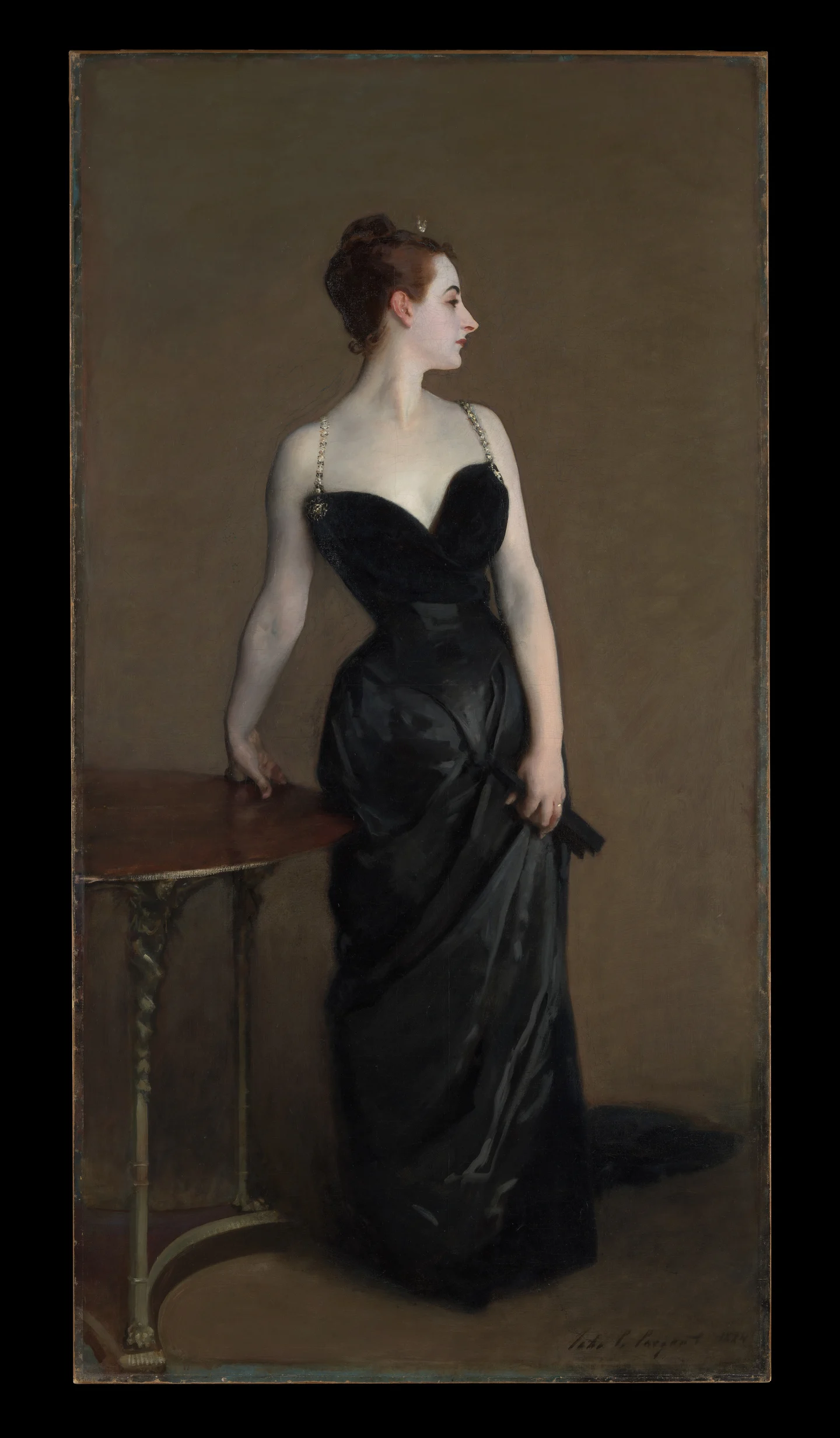
The finished canvas measures 208.6 by 109.9 centimeters — nearly seven feet tall, formatted to dominate. 5 Gautreau stands in right profile, body facing the viewer, head turned away. Her left hand rests on a low wooden table whose legs are carved with siren figures — a classical flourish she almost certainly chose herself. Her right hand holds a folded black fan.
The silhouette is severe. A black evening gown with a heart-shaped velvet bodice cinches tightly at the waist, the satin skirt pooling toward the floor and dissolving into the shadow so that her legs seem to float above ground. The only jewelry: two jeweled shoulder straps and a gold wedding band on her right hand. 6 The diamond crescent tiara sits in her dark hair.
Her skin is the painting's most deliberate provocation. Sargent described it to Vernon Lee in February 1883 as a "uniform lavender or blotting-paper colour all over" — and in the painting he made that pallor read as almost spectral, every inch of her décolletage flattened to a single milky plane. 3 Against that white, her ear is conspicuously red. Art historian Elizabeth Prettejohn described it as "a jarring reminder of the color of flesh unadorned." The whole figure exists in a kind of uncanny valley — too pale to be alive, too precisely rendered to be a sculpture.
Behind her: a warm brown field, deep and luminous, that closes off the world entirely. Sargent had earlier considered a different background. He wrote to Castillo that at one point he was dissatisfied and "dashed a tone of light rose over the former gloomy background," then turned the canvas upside down, walked to the other end of the studio, and looked at it from between his legs. "Vast improvement," he decided. 3 The final brown was settled after the Salon.
As for what the palette actually contains, the answer from the visible surface would have surprised a chemist. Sargent's apparent blacks and whites are built from lead white, rose madder, vermilion, viridian green, and bone black — a range of hue that looks, at arm's length, almost monochrome. 7 The art works through contrast, not color.
"One more struggle, and the lady will be free"
The 1884 Salon opened May 1. Sargent entered the painting as his seventh consecutive showing. 1
The problem was the right shoulder strap. Sargent had painted it fallen — not sitting on the shoulder as it does now, but drooping down the upper arm, suspended by nothing. A Le Figaro critic looked at the resulting picture of Gautreau and wrote drily: "One more struggle, and the lady will be free." 1 The satirical magazine La Vie Parisienne published a caricature that took the joke to its conclusion, showing Gautreau with her bodice fully open, captioned with a dialogue: "Mélie, your dress is falling off!" / "It's on purpose. … And leave me alone anyway, won't you?" 1
The L'Événement critic wrote that "Mr. Sargent made a mistake if he thinks he expressed the shattering beauty of his model… Even recognizing certain qualities that the painting has, we are shocked by the spineless expression and the vulgar character of the figure." 1 The Art Amateur accused Sargent of manufacturing the controversy for publicity.
What drew the particular fury was not nudity — the Salon that year contained plenty of that, in the form of acceptable mythological nudes. What offended was that Gautreau was known. She was a married woman, a named socialite with a banking husband and a daughter, her wedding ring visible in the painting. Dress historian Aileen Ribeiro put it bluntly: "The dress is so scandalous even an actress would have thought twice about wearing it for a portrait." 8 The fallen strap, on an anonymous mythological figure, would have caused no comment at all. On her, it implied consent to something.
Gautreau and her mother came to Sargent's studio, according to his own account, "bathed in tears," and demanded the canvas be withdrawn from the Salon. Sargent refused. He told them he had painted her "exactly as she was dressed, that nothing could be said of the canvas worse than had been said in print of her appearance." 1 He had painted her as she was — she had simply never expected anyone to say so in public, at that scale, on that wall.
What the X-rays found
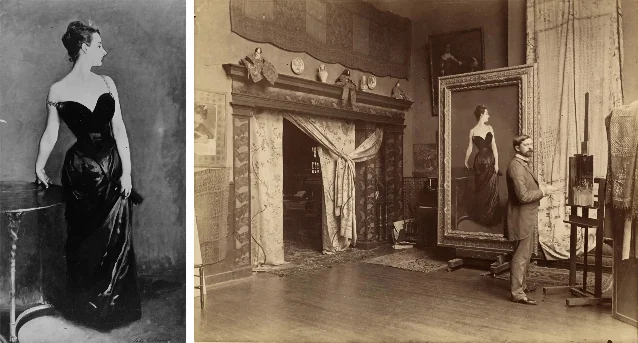
The repainted strap is visible in a photograph taken in Sargent's Paris studio around 1885, where it sits securely on the shoulder as it does today. What happened beneath the surface, however, remained invisible for over a century. In 1995, the Metropolitan Museum conducted a comprehensive technical examination of the canvas using X-radiography and infrared reflectography. 6
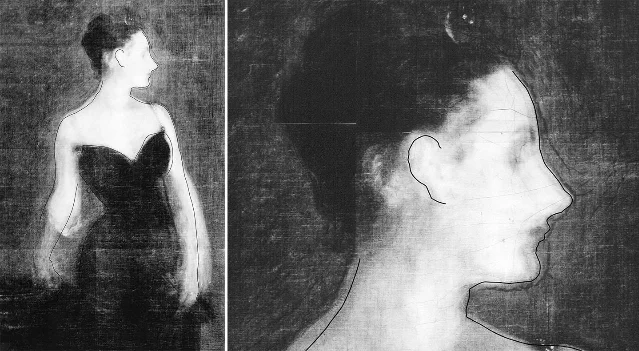
The results were startling. The X-rays showed not just the fallen strap concealed under the repainted one, but a more restless canvas than anyone had suspected. Sargent had adjusted the profile multiple times. The position of the ear had shifted significantly. Both arms had been moved. The figure was pinned down through iteration, not inspiration.
A decade later, in 2005, Met conservators Dorothy Mahon and Silvia A. Centeno published the results of a scanning X-ray fluorescence study that mapped the distribution of elements across the entire painting. 6 The "black" dress, it turned out, was saturated with viridian green. The original background — still visible as a thin stripe of color along the painting's edges, where it survived because the canvas was framed when Sargent repainted — was cerulean blue.
Mahon and Centeno wrote that the XRF images "are a testament not only to Sargent's strength as a colorist, but also to his involved creative process. They offer a window on the artist's mind at work… every detail of the finished surface is the result of many decisions that remain invisible to the naked eye." 6
The thirty-year custody
The 1884 Salon ended Sargent's Paris career. He relocated to London, where his friend Henry James had promised a more sympathetic reception — though British critics initially responded with equal hostility. The Misses Vickers, his Royal Academy entry the following year, was voted worst painting of 1886. His painting Carnation, Lily, Lily, Rose, bought through the Chantrey Bequest, provoked enough argument that artists "almost came to blows" over it. 9
He brought Madame X with him to London. He hung it in his Tite Street studio and refused all offers to sell. Starting in 1905, he began showing it in international exhibitions, where critical opinion was warmer. The portrait of a woman who had destroyed his Paris standing was also, by then, the painting that made the most people stop and stare.
Gautreau, for her part, didn't vanish entirely. She grew more selective in her social appearances but did not retreat. In 1891, she sat for the French artist Gustave Courtois, who painted her in a strikingly similar profile pose — with a similarly dipped neckline — and this time the public found the picture admirable. In 1898 she sat for Antonio de La Gándara, producing what biographers describe as her favorite portrait of herself. 2 She and Pierre eventually lived separately after their daughter Louise's marriage in 1901.
She died in Paris on July 25, 1915, at fifty-six.
One year later, Sargent wrote to Edward Robinson, Director of the Metropolitan Museum of Art. He was willing to sell. The price was £1,000 — approximately $4,860 at 1916 exchange rates. Through the Arthur Hoppock Hearn Fund, the Met accepted. 6
Sargent added one condition: "I should prefer, on account of the row I had with the lady years ago, that the picture should not be called by her name." 6 And so the portrait of Virginie Amélie Avegno Gautreau, socialite, Confederate orphan, la belle, became Madame X — the name that has followed it ever since.
In the same letter, he offered his own assessment: "I suppose it is the best thing I have done." 6
From scandal to the American Wing
The New York Herald headline on May 12, 1916 read: "Sargent Masterpiece Rejected by Subject Now Acquired by Museum." The framing was essentially correct. A painting that had cost its maker his French career, that had been demanded off the wall by a weeping mother, was now entering a permanent collection — acquired not in spite of what it had once meant but partly because of it.
The rehabilitation had been gradual. By the 1890s, Belle Époque fashion had caught up to the aesthetic the painting had once made shocking: the dramatic simplification of dress, the confidence of a woman standing alone without needing to be explained. Henry James, who had known Sargent in Paris and followed his career closely, praised his "faculty of taking a fresh, direct, independent, unborrowed impression." 9 In 1902, Auguste Rodin called Sargent "the Van Dyck of our times."
The Musée d'Orsay now describes Madame X as "the Mona Lisa of the American art collection conserved by the Metropolitan Museum of Art." 10 In 2025, the painting left New York for the first time since its scandalous debut — returning to Paris for the Musée d'Orsay's exhibition Sargent: The Paris Years (1874–1884), running through January 11, 2026. 10 For the first time in 141 years, the canvas was back in the city where a crowd once gathered to mock it.
What had changed was not the painting. The fallen strap was repainted in 1884 and has not moved since. The cerulean blue background is still entombed beneath the brown, still faintly visible at the edges. The ear is still red, the skin still lavender-white, the fan still folded in her right hand. What changed was the city around it — its understanding of what it means to look directly at a woman who is looking somewhere else, and to find the act of looking so unsettling.
Sargent died in April 1925, in his sleep, with a volume of Voltaire beside him. His friend Vernon Lee, asked later to summarize the man, said the only adequate description was two words: "He painted." 9
Madame X hangs today in Gallery 771 of the Metropolitan Museum's American Wing — accession number 16.53, acquired 1916, still listed in the catalogue as "Madame X (Virginie Amélie Avegno Gautreau), 1883–84." The anonymity Sargent requested didn't last. It never really could. 5
Cover image: John Singer Sargent, Madame X (Virginie Amélie Avegno Gautreau), 1883–84, oil on canvas. Metropolitan Museum of Art, accession 16.53. CC0 Public Domain
References
- 1Wikipedia: Portrait of Madame X
- 2Wikipedia: Virginie Amélie Avegno Gautreau
- 3JSS Gallery: John Sargent's Madame X
- 4BBC Culture: Who was the mysterious Madame X?
- 5Metropolitan Museum of Art Collection API: Madame X
- 6Met Conservation: Revealing Madame X
- 7Draw Paint Academy: A Closer Look at Portrait of Madame X
- 8FIT Fashion History Timeline: 1884 — John Singer Sargent, Madame X
- 9The Guardian: How John Singer Sargent made a scene
- 10The Cultivist: Masterpiece Spotlight — The Story Behind 'Madame X'
Add more perspectives or context around this Post.