June 10 in Business History: The $1,298 Bet, the Frozen Beef, the Car Built by Pilots, and the Law That Took 60 Years to Half-Work
Four events on June 10, spanning 108 years: In 1869, a Texas physician ships thirty frozen beef carcasses on the steamship Agnes to New Orleans, proving refrigeration could transform food logistics — a proof-of-concept that spawned today's $371 billion cold chain industry. In 1947, Saab's aircraft engineers, with only two driver's licenses among 16 team members, unveil the Ursaab prototype — a car later destroyed by GM's rebadging strategy. In 1963, JFK signs the Equal Pay Act, which moved women's wages from 59 cents to 85 cents on the dollar in 61 years. In 1977, Apple ships the Apple II at $1,298 — nearly twice the price of rivals — and accidentally builds the business computer market by creating a platform that VisiCalc could transform.
Four events on June 10, spread across 108 years, each seeded an industry or rewrote the rules of an existing one. A California electronics company shipped a computer it hoped housewives would buy. A Texas physician sent frozen beef on a steamship and proved that refrigeration could move food across distance. A Swedish aircraft maker presented a car prototype built by engineers who barely knew how to drive. And a president signed a wage law that business groups swore would destroy itself — and didn't.
1869: The steamship Agnes docks in New Orleans with thirty frozen beeves
Before June 10, 1869, meat moved in one of two ways: alive or salted. A cattle drive from Texas to Kansas took two months, covered roughly 15 miles a day, and required 10 or more cowboys for a herd of 3,000. 1 Roughly 60% of each animal's live weight was bone, hide, and offal — shippers paid full freight on parts that couldn't be eaten. 2 After the Civil War, Texas cattle sold for as little as $2 per head while Northern buyers paid $40. The gap was real; what was missing was the physics. 1
On June 10, 1869, the Morgan Line steamship Agnes arrived at New Orleans from Indianola, Texas — then the state's largest port — carrying thirty beef carcasses in a cold-storage room measuring 25 feet by 50 feet. 3 The organizer was Henry Peyton Howard, a San Antonio physician-turned-entrepreneur who had fitted the ship with a carbon dioxide compression system. The same technology had been developed by Thaddeus S.C. Lowe to inflate military balloons; Howard adapted it for food transport. 3 The beef arrived in, as later reports described it, "very excellent condition" and was served at hospitals and presented at a celebratory banquet Howard threw at the St. Charles Hotel. 3
The proof-of-concept took a decade to industrialize. In 1878, Gustavus Swift hired engineer Andrew Chase to design an ice-cooled railroad car with ice positioned in roof compartments so cold air circulated downward. 2 Major railroads refused Swift's cars — they had invested in stock pens and live-cattle infrastructure and saw no reason to strand those assets. Swift contracted with the Grand Trunk Railway (which had little live-cattle business) to run his cars through Canada to Eastern markets. 2 The numbers followed: live cattle deliveries to New York fell from 366,487 tons in 1882 to 280,184 tons in 1886, while dressed-beef deliveries rose from 2,633 tons to 69,769 tons in the same four years. 2 By the early 20th century, Chicago's stockyards produced 82% of domestic U.S. meat consumption. 4 Historian William Cronon wrote that because of the Chicago packers, "ranchers in Wyoming and feedlot farmers in Iowa regularly found a reliable market for their animals, and on average received better prices." 4 Today the global cold chain logistics market is estimated at roughly $371 billion annually. 5
Mirror: Howard's voyage is the prototype for every infrastructure proof-of-concept that incumbents dismiss. Railroads rejected refrigerated cars because they had invested in live-cattle pens. The innovation didn't need their blessing — it needed one cooperative carrier willing to move a single shipment. When an existing supply chain has a structural inefficiency this large ($2/head in Texas vs. $40/head in New York), the question for today's operator isn't whether the bottleneck will be solved, but how fast and by whom. The decisive advantage belongs to whoever builds the new infrastructure before incumbents decide it threatens them.
1947: Saab, the airplane maker, unveils a car it designed without any carmakers
Saab (Svenska Aeroplan Aktiebolaget) was founded in 1937 to build warplanes for Swedish neutrality. 6 By 1945, with the war ending and military aircraft demand collapsing, the company needed a new product. It started Project 92 with a 16-person team led by engineer Gunnar Ljungström and industrial designer Sixten Sason. Only two members of the team had driver's licenses. None had ever built a car. 7
The prototype — code name 92001, later called the Ursaab — was built by hand in an underground factory 30 meters below ground, with workers hammering 1.2mm steel sheets over wooden jigs. 7 The car completed in summer 1946, but Saab waited until June 10, 1947 to present it publicly at its Linköping headquarters. 8 The Ursaab logged more than 530,000 kilometers of test mileage before production — typically driven on narrow, muddy forest roads at dawn or late at night to stay out of sight. 7
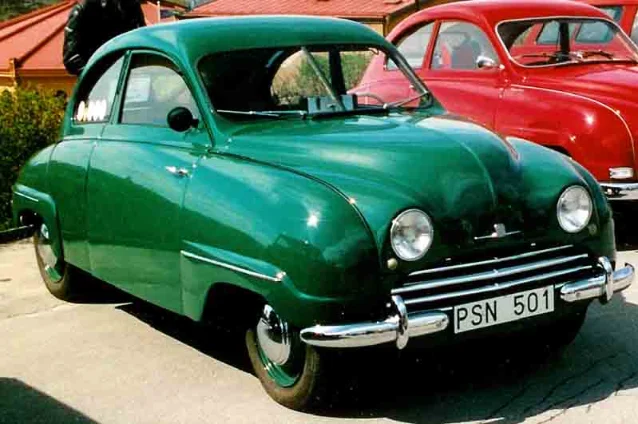
The aerospace origins were legible in every engineering decision. The Ursaab's drag coefficient was 0.30 — exceptional for 1947, when most production sedans sat above 0.50. 7 The monocoque body structure came from aircraft fuselage design. Front-wheel drive was chosen for traction on Swedish winter roads. When the Saab 92 reached production in December 1949, all 20 early cars came painted in a single color: dark forest green, because the factory had purchased surplus camouflage paint from the Swedish military and saw no reason to waste it. 9 Between 1949 and 1957, Saab produced 20,128 units of the 92. 9
The creative arc was more impressive than the commercial one. The Saab 900 — introduced in 1978 — became the brand's most iconic model and sold close to 1 million units. 6 Then came the acquisition sequence. GM paid $600 million for 50% of Saab Automobile in 1989, then bought the remaining 50% for $125 million in 2000. 6 GM introduced the Saab 9-2X — a rebadged Subaru Impreza — and the Saab 9-7X — a rebadged Chevrolet Trailblazer. Both failed commercially. 6 In February 2010, GM sold Saab to Dutch sports car maker Spyker Cars for $74 million in cash plus $320 million in Spyker stock — a company that built fewer than 50 cars per year. 10 On December 19, 2011, Saab Automobile filed for bankruptcy with $500 million in assets against $2 billion in liabilities. 10 Matthias Holweg and Nick Oliver of Cambridge Judge Business School concluded that Saab "could have been for General Motors what Audi became for Volkswagen: a premium, fully integrated brand with a clear, distinct image. Yet scale diluted the very individuality that was a hallmark of the Saab brand." 11 Their sharper point: "Limited numbers of enthusiastic customers cannot keep a company alive in industries that rely on scale economies — no matter how iconic the brand." 11
The parent company survived. Saab AB's defense aerospace division posted 20–24% organic sales growth in 2025, with record order backlogs. 6 The Gripen fighter jet program — the core product of the original aircraft business — is running above capacity. The company that built cars because it needed to diversify from warplanes is now thriving on warplanes again.
Mirror: Adjacent-market entry works when you apply genuine capability, not just existing brand equity. Saab's engineers gave the Ursaab a 0.30 drag coefficient because aerospace knowledge was real and transferable. That part worked. What destroyed Saab Automobile later was a different problem: GM treating a cult brand as a platform for rebadging economies, which is the opposite of why cult brand customers pay premium prices. For any acquirer eyeing a premium niche brand: the platform-sharing synergies are real; the customer tolerance for dilution is much lower than the spreadsheet assumes.
1963: JFK signs the Equal Pay Act — and calls it a first step
The business community's argument against the Equal Pay Act was internally coherent: women cost more to employ because of higher absenteeism, higher turnover, and state laws requiring rest breaks and separate facilities. The U.S. Chamber of Commerce and the National Retail Merchants Association also noted that 21 states already had equal pay statutes, making federal legislation redundant. 12 Congress neutralized most of that opposition by attaching the bill to the Fair Labor Standards Act — which already had established enforcement procedures — rather than creating new regulatory machinery. The language shifted too: Esther Peterson, the bill's driving force, had wanted "equal pay for comparable work"; Congress settled on the narrower "equal pay for equal work." 13
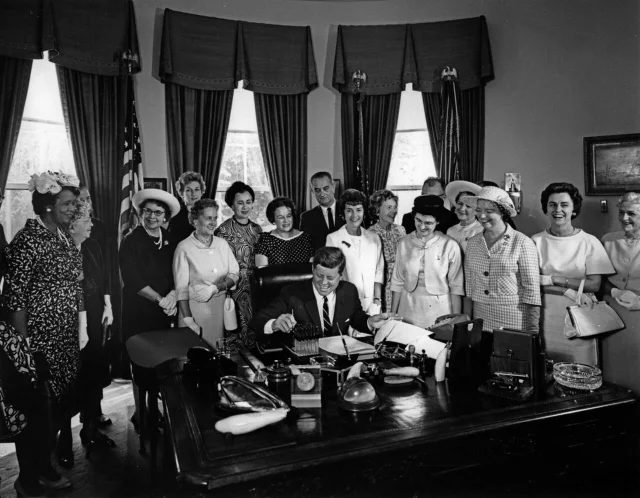
Peterson — head of the Women's Bureau in the Department of Labor and the highest-ranking woman in the Kennedy administration — had spent nearly two years building the legislative coalition. In a 1970 oral history interview at the JFK Library, she was direct: "Equal pay was never top priority at the White House. The White House helped me at certain times, but I've literally carried that bill up." 13 At Kennedy's urging, she had also established the President's Commission on the Status of Women in December 1961, chaired by Eleanor Roosevelt. 15 On June 10, 1963, Kennedy signed the act (Pub. L. 88-38) and described it as a "first step" toward full economic equality, acknowledging that "much remains to be done." 12
The business opposition's specific prediction — that the law would reduce female employment as employers shifted to male workers — did not come true. Women's labor force participation increased from roughly 34% in 1963 to approximately 57% by 2026. 14 What did persist was the gap the law was meant to close. In 1963, women working full-time, year-round earned 59 cents for every dollar men earned. 14 By 2024, Pew Research measured the figure at 85 cents for all workers (full- and part-time) based on median hourly earnings — a 26-cent gain across 61 years. 16 The gap is narrower for workers ages 25–34, at 95 cents in 2024, suggesting that the structural drivers are shifting more quickly for younger cohorts. 16 The Center for American Progress estimated that since 1967, working women have cumulatively lost $61 trillion in wages due to the persisting gap. 17 The law has not worked alone. The Lilly Ledbetter Fair Pay Act of 2009 — the first bill Barack Obama signed, nine days into his presidency — amended Title VII to reset the statute of limitations on pay discrimination claims with each discriminatory paycheck, overturning a 2007 Supreme Court ruling that had effectively time-barred most claims. 18 The EEOC has collected over $85 million in monetary relief for sex-based wage discrimination since 2010. 19
Mirror: The business groups that opposed the Equal Pay Act in 1963 were right that compliance had costs. They were wrong about the trajectory. Companies that built pay-equity practices early gained a recruiting edge as women's educational attainment surged — women now hold more bachelor's and advanced degrees than men. The pattern from the Equal Pay Act repeats across regulatory history: initial industry opposition, compliance infrastructure built, late adopters face higher costs and talent disadvantage. For HR and compensation executives today: the question isn't whether pay transparency and equity audits will be required — multiple state laws already mandate them — but whether your organization builds the infrastructure before the mandate or after.
1977: Apple ships the Apple II — and accidentally creates the business computer market
On June 10, 1977, Apple Computer Inc. shipped the first Apple II personal computers from its Silicon Valley operation. 20 The base configuration cost $1,298 (about $6,900 in 2025 dollars), came with 4 KB of RAM upgradable to 48 KB at $2,638, and ran a MOS Technology 6502 processor at 1.023 MHz. 21 Byte magazine later named it one of the "1977 Trinity" alongside the Commodore PET 2001 ($795) and Tandy TRS-80 Model I ($599). 21 Apple's machine was nearly twice the price of its nearest rival and the only one of the three with color graphics, eight expansion slots, and a molded plastic consumer-appliance case.
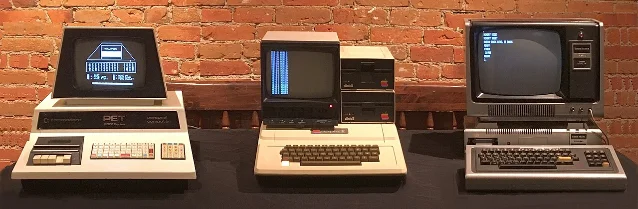
Steve Wozniak designed the hardware entirely — color graphics circuitry, the Disk II controller, and the switching power supply (designed by Rod Holt, smaller and cooler-running than the linear supplies competitors used). Steve Jobs drove the product decisions: a fully assembled consumer-ready appliance rather than a kit, a plastic case designed by Jerry Manock with the aesthetic of a kitchen appliance, rainbow stripes on the Apple logo to showcase the machine's color capability. 21 Mike Markkula, a retired Intel marketing manager, put in $250,000 (about $1.33 million in 2025) and wrote Apple's first business plan projecting $500 million in revenue within 10 years. 23
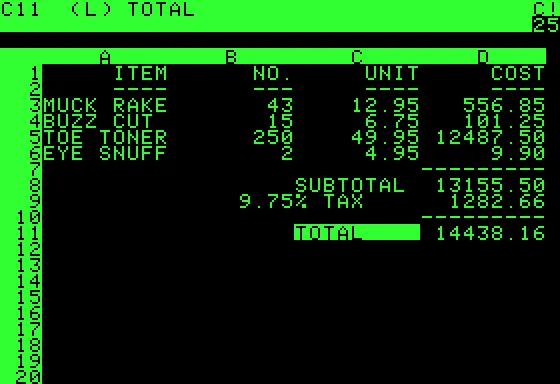
The market that showed up wasn't the one Apple expected. Wozniak later said that small businesses, not hobbyists, purchased 90% of Apple IIs. 24 The reason became clear in October 1979, when Software Arts released VisiCalc — the first personal computer spreadsheet — exclusively for the Apple II at $100. 25 Dan Bricklin designed it after watching a Harvard Business School professor erase and redo an entire financial model on a blackboard after finding a single error; his insight was that recalculation could be automated. 25 Analyst Ben Rosen wrote in July 1979 that VisiCalc "could someday become the software tail that wags (and sells) the personal computer dog." 25 He was right: more than 25% of Apple IIs sold in 1979 were reportedly purchased specifically to run VisiCalc. 26
Apple's revenue grew from $775,000 in fiscal year 1977 to $118 million in fiscal year 1980. 23
The Apple II series ran for 16 years, spanning six models (II, II Plus, IIe, IIc, IIc Plus, IIGS) and selling approximately 6 million units total. 23 Even after the Macintosh launched in January 1984, the Apple II still accounted for 85% of Apple's hardware sales revenue in the first fiscal quarter of 1985. 24 Apple Computer went public on December 12, 1980 at $22 per share, raising over $100 million — the largest U.S. IPO since Ford Motor Company in 1956 — and creating approximately 300 millionaires. 27 Apple became the first company globally to reach a $1 trillion market cap (August 2018), $2 trillion (August 2020), and $3 trillion (January 2022 intraday). By October 2025, its market valuation stood at just over $4 trillion. 27
Mirror: Apple priced the Apple II at nearly 2x its competitors and gained more market share, not less — because the expansion slots and color graphics turned it into a platform that third parties could build on, and VisiCalc made it indispensable to buyers who would never have described themselves as computer enthusiasts. The decision to be a platform rather than an appliance is why the Apple II funded everything Apple did for the next decade. For product and pricing decisions today: when you're entering an undefined category, premium pricing combined with genuine openness to developer extensions can outperform low-price / closed strategies — provided the platform actually delivers on the capability premium.
Cover image: AI-generated editorial illustration.
참고 출처
- 1Wikipedia: Cattle drives in the United States
- 2Wikipedia: Gustavus Franklin Swift
- 3Texas State Historical Association: Refrigeration
- 4Wikipedia: Union Stock Yards
- 5Fortune Business Insights: Cold Chain Logistics Market
- 6Wikipedia: Saab Automobile
- 7Wikipedia: Ursaab
- 8SaabPlanet.com: June 10, 1947
- 9Wikipedia: Saab 92
- 10Wikipedia: Bankruptcy of Saab Automobile
- 11Cambridge Judge Business School: Who killed Saab Automobile?
- 12National Park Service: Equal Pay Act of 1963
- 13HISTORY: Esther Peterson
- 14Wikipedia: Equal Pay Act of 1963
- 15AFL-CIO: Esther Peterson
- 16Pew Research Center: Gender pay gap in U.S.
- 17Center for American Progress: Gender Wage Gap at 60
- 18Wikipedia: Lilly Ledbetter Fair Pay Act of 2009
- 19EEOC: Equal Pay Act of 1963
- 20Computer History Museum: June 10
- 21Wikipedia: Apple II (original)
- 22Wikipedia: Commodore PET
- 23Wikipedia: Apple II
- 24Apple II History: When The Apple II Was New
- 25Wikipedia: VisiCalc
- 26Low End Mac: VisiCalc and the Rise of the Apple II
- 27Wikipedia: Apple Inc.
이 콘텐츠를 둘러싼 관점이나 맥락을 계속 보강해 보세요.